How much of your fuel price is tax?
Across the European Union, tax is the bigger half of what you hand over at the pump. These are the official figures for all 27 countries, from one source and one week. They also explain something people rarely expect: strip the tax away, and fuel costs almost the same everywhere.
Country by country
How much of the petrol price is tax
Sorted from heaviest to lightest. Shown at full strength: the countries Fillz covers.
European Commission, Weekly Oil Bulletin, week of 2026-08-31
Read it as a map of national choices, not of luck. Every country in this list buys its fuel on the same world market. What separates the top of the chart from the bottom is what each government decided to charge on top.
Malta sits apart and deserves a note: its pump prices are set by the state rather than by the market, so its untaxed figure is not comparable with the rest in the way the others are with each other.
The short answer
Tax as a share of the petrol price
Euro-super 95, the 27 countries of the European Union.
Sweden
of the 27
Malta
European Commission, Weekly Oil Bulletin, week of 2026-08-31
In the lightest-taxed country in the Union, roughly three in every ten euros you pay for petrol are tax. In the heaviest, it is more than half. Twelve of the twenty-seven are at or above 50%.
That spread is not a rounding difference between neighbours. It is the single biggest reason fuel costs what it costs where you happen to live.
What one litre is actually made of
The average European litre of petrol
The unweighted average of the 27 countries.
European Commission, Weekly Oil Bulletin, week of 2026-08-31
There are two taxes on that litre. Excise duty is a fixed amount per litre, set nationally, and it does not move when oil moves. VAT is then added on top of everything, including the excise, so part of what you pay is a tax charged on a tax.
The rest, the part that is not tax, is the fuel as a product: crude oil, refining, getting it to the forecourt, and the station's own margin. That is the only half that world markets can push around.
Take the tax away and the fuel costs the same
The same litre, two countries
Petrol, the same week.
Portugal
48.8% goes to the state.
Sweden
29.6% goes to the state.
European Commission, Weekly Oil Bulletin, week of 2026-08-31
At the pump these two countries are 0.542 € a litre apart. Before tax they are 0.003 € apart. Three tenths of a cent. The entire gap a Portuguese driver feels against a Swedish one is tax, and nothing else.
The pattern holds across the whole Union. Pump prices range over about 1.05 € a litre from cheapest country to dearest, but untaxed prices range over only 0.43 €. Fuel is close to a single European commodity. What is not single is the tax on it.
Diesel is taxed less than petrol. In all 27.
Averaged across the Union, tax is 47.5% of the petrol price and 40.2% of the diesel price, a gap of about 7.3 points. This is not a tendency with exceptions. Diesel carries the lower excise in every single one of the 27 countries.
The reason is historical rather than environmental: diesel moves freight, and cheaper freight was treated as an industrial policy. Several countries have been closing the gap since, but none has closed it.
And yet diesel is now the dearer fuel at the pump in most of Europe, despite that lighter tax. We followed that reversal in diesel is no longer the cheap fuel.
A lighter tax does not automatically make diesel the cheaper choice for you. That depends on what your car burns per hundred kilometres, what it costs to buy and service, and how far you drive in a year. The tax gap only tells you where the starting line is.
Why the share barely moves
Excise is a fixed number of cents per litre. It does not care what a barrel costs this morning. So when oil rises, the untaxed half of the price grows while the excise stays put, and the tax share quietly falls. When oil drops, the share climbs back.
VAT behaves the other way, since it is a percentage of the whole. The net effect is that the share moves far more than most people assume. Across 2025 and 2026 alone, the tax share of petrol swung by a median of 10 points inside a single country, and by 25 points in Sweden. What barely moves is the excise itself, counted in cents per litre. So read every percentage on this page as a photograph of one week, not as a permanent national setting.
What this changes for you
Nothing on this page is a lever you can pull. You cannot opt out of the excise, and the oil price is not listening. What the numbers do is narrow down where a saving can still come from.
Inside one country, every station pays the same tax on the same litre and buys on the same market. So the difference between the cheap pump and the dear one two streets away is almost entirely margin, and margin is decided locally, by competition. That difference is small per litre and large per year.
It is also the one part of the price that rewards paying attention, which is the whole reason Fillz exists: it shows the nearby prices, and it counts the fuel you burn on the detour before telling you a station is worth it.
Common questions
Why is my country so high up the chart?
Because excise is decided nationally and VAT is charged on top of it. A country with both a high excise and a high VAT rate compounds the two, and lands near the top.
If oil gets cheaper, does my bill fall by as much?
No. Only the untaxed part of the price can move, and in most of the Union that is under half of it. A ten per cent fall in the cost of the product is a much smaller fall on the sign.
Where do these numbers come from?
From the European Commission, which publishes the prices of every member state each week, both with and without taxes. The tax share on this page is the difference between the two, for the same country, fuel and week.
What about the United Kingdom, Norway, or countries outside Europe?
They are missing here for an honest reason. This comparison works because 27 countries are measured the same way, on the same day, by the same body. No equivalent source exists across the rest, and stitching together national figures collected on different dates and different definitions would look like a comparison without being one.
You cannot choose the tax. You can choose the pump.
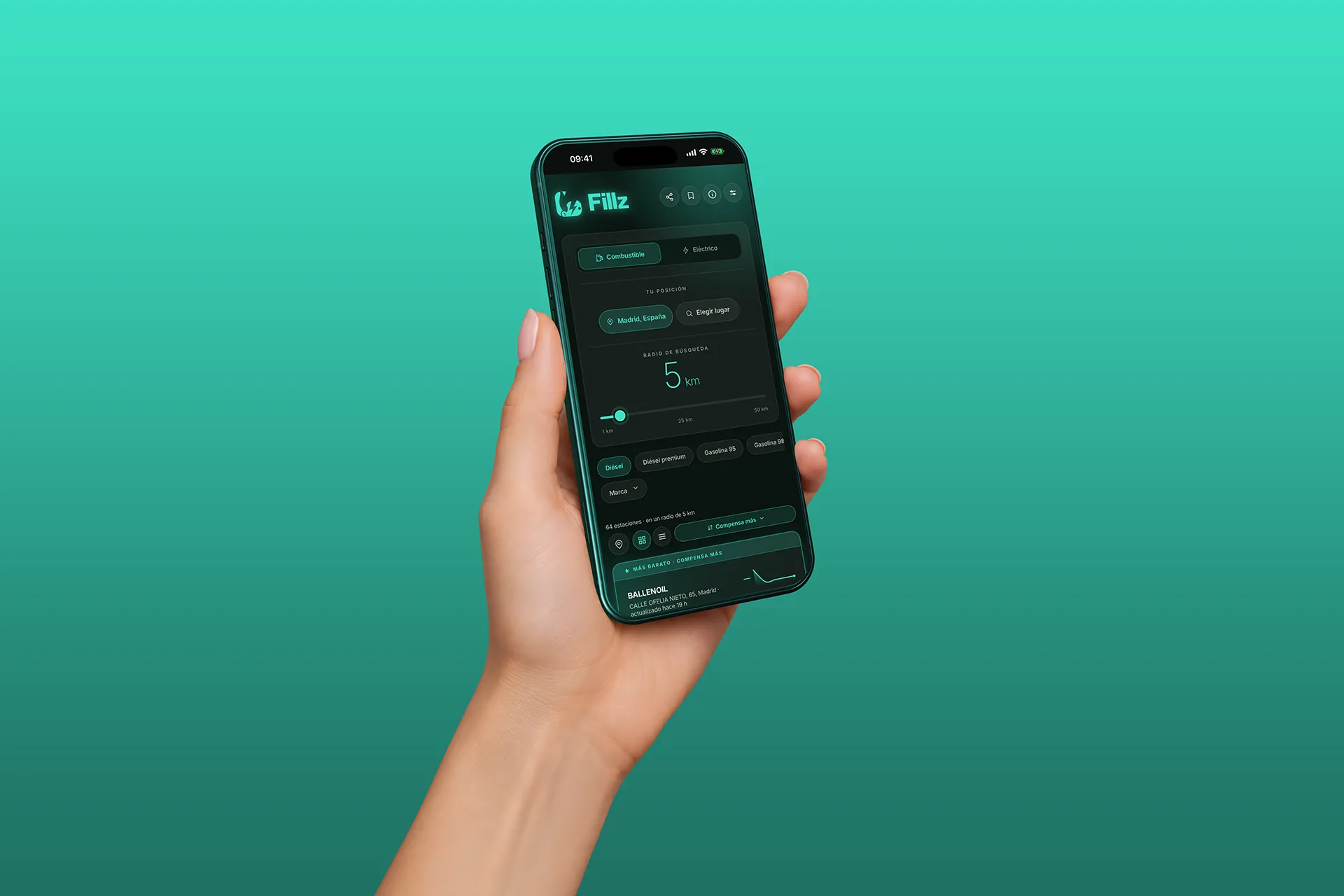
Half of what you pay was decided in a parliament. The other half is a market, and inside it the station you pick still matters. Fillz shows you the nearby prices and works out whether the cheaper one survives the detour.
Open Fillz